Feed on
Posts
comments

Postsecret

I am a HUGE fan of Postsecret. I am not sure if you know about this community art project but an American man started leaving random notes asking strangers to send him a postcard sharing their secrets with him.

It started a phenomena and is ongoing. Selected cards have been turned into beautiful books and his web site posts some of the many hundreds of cards he receives from around the world each week.

I love this Youtube clip that features some really uplifting Postcards…many deal with beauty, friendship and the relationship between mothers and their daughters.

Enjoy.


A Lot To Lose

In a number of past posts we have discussed the binge drinking epidemic in our youth:

Let’s get smashed - a South Australian perspective

Getting Trashed is so hot right now 

I discovered the following series of short films on site www.2much2lose.com. I believe they will be great catalyst for conversation.

The films are all part of a teen directive started by the Century Council, a Washington based non-profit organisation aimed at curbing youth drinking. This particular campaign aimed at encouraging girls to see that underage drinking is not worth the adverse consequences it can cause.

The Council’s “Reel Girls, Real Life” contest encouraged girls nationwide to submit concepts for television Public Service Announcements to dissuade peers from drinking. The winner, Kylee Darcy’s films feature two teen girls, “Kristen” and “Sarah,” who are shocked to discover that a video of “Sarah” drinking at a party surfaced on a social networking web site - “What You Don’t Know”. The girls explain that they felt “Alone,” were “Benched” and got “Busted.”


The following questions may be useful starting points ( thanks to my program Director for Queensland, Storm Greenhill Brown, for her help with these):

1. Australian studies have shown that as many as one in five teenage girls say they have done something they regret when drunk. Have you ever observed others acting in a way they wouldn’t normally act as they were drunk? How did this make you feel?
2. This series focuses on some of the possible social ramifications of binge drinking. What physical dangers are there in excessive drinking? How are you more vulnerable and exposed?
3. What steps could you take to minimise risks like this for yourself and your friends?
4. When you see a group of friends behaving in a way that makes you anxious what would you do? How could you take control of the situation?
5. The teenager in the clip says that she didn’t realise that she was so “out of control” - is that boundary easy to cross?
6. What, in your opinion, would be the top three reasons that teenage girls binge drink and why?
7. Do you think that this campaign on the negative effects of binge drinking is successful in getting its message across? How could it be better?

Guiding the way…

This week I want to share extracts from “Teenage Mental health: girls shout out!”, the third research report recently released by GirlGuiding UK:

Teenage mental health: Girls shout out! is an investigation into girls’ experiences of both hard-to manage and challenging feelings and recognised mental health problems. The report considers a new generation of potential triggers for mental health problems in girls - premature sexualisation, commercialisation and alcohol misuse - and also some of the more longstanding issues like bullying and family breakdown. It examines the impact of such factors on girls’ feelings and behaviour at home and in their communities, and asks young women themselves what might be done to help.” 

Some of the statistics are frightening and yet they are consistent with the many other studies that have also examined the impact our toxic culture is having on young women:

• Half the girls questioned know someone who has suffered from depression (51 per cent).
• Two-fifths know someone who has self-harmed (42 per cent).
• A third have a friend who has suffered from an eating disorder (32 per cent).
• Almost two in five have a friend who has experienced panic attacks (38 per cent).
• A quarter know someone who has taken illegal drugs (27 per cent).
• Two-fifths have experience of someone drinking too much alcohol (40 per cent).

It would be easy to feel overwhelmed wouldn’t it? But girls don’t need our dismay - they need us to get active.    

What types of things can be done to support girls’ emotional well being? The report also offers some practical suggestions:

1. Give girls things to do: from adventure playgrounds to kung fu or street dancing.
2. Create safe places where girls can have freedom without parents worrying.
3. Boost confidence by giving girls opportunities to succeed outside school.
4. Encourage girls to try something new.
5. Make girls feel normal and accepted - whatever problems they might have.
6. Don’t overwhelm them with advice - give them space.
7. Help them understand that they can’t always help the way they feel.
8. Initiate a young mayor scheme - giving girls a say in important decisions.
9. Make information about where to turn for help easily available.
10. Use the Girlguiding UK website to offer advice and support.
 

I would add to this the following ideas:

1. Empathise - don’t dismiss her fears and anxities, nor think of her as a mere “drama queen.” Being a teen girl is challenging at times, and I believe this generation of girls have it even harder than we did. A great exercise that may help you reconnect with what it feels like to be a teenager was offered in one of my previous posts: Letter To My Teen Self. Do take the time to read the letters other Butterfly Effect readers contributed - they are so insightful. Add a letter of your own!
2. Help girls develop a language to describe how they are feeling; develop their emotional literacy.
3. Encourage girls to seek out a “Fairy Godmother” - a mentor who can help her navigate these tumultueous years. Enlighten’s Program Director for Victoria, Sonia Lyne, discussed this with great honesty and warmth in her previous guest post True Colours.
4. Get informed. Read books from
My Library, read some of the articles on my Article of Interest page, watch some of the films in my Video Pod, visit some of the other web sites I recommend.
5. Encourage girls to critique the media messages that surround them. This blog has offered a variety of great practical activities that get girls active eg: my post on Talking Back to the Media. 

The entire GirlGuiding report is so well worth reading that I am providing the PDF here for you and a “virtual treat” for you to have whilst taking 5 minutes to really think about how you can respond intelligently and compassionately to the pressing needs of the girls you care for…  

Guiding UK Report on Teenage Mental Health

One final request - spread the word. For some reason our readership has dropped off significantly of late. I want to connect all schools and parents to the dialogue. Do you have a friend or colleague you could pass on this link too?

P.S I cannot help but say a special “Girl Guide” howdee to my Program Manager for South Australia Jane Higgins. Within Enlighten we affectionately refer to Janey as our “Brownie” - an ex-Girl Guide, she is THE most well prepared gal I know. WE love you Little Miss Be Prepared! :)   

I stumbled upon another great American site in my cyber - world travels this week that I think is worth sharing:

www.loveyourbody.nowfoundation.org

This organisation runs a number of really interesting initiatives. One is the “Love Your Body” campaign which is launched each year with a poster competition:

The grand prize winning poster will be used as part of a national campaign to challenge the media’s use of violent, drug-addicted, starved, surgically-enhanced images of women and to fight against industries that profit from women’s dissatisfaction with their bodies.”

 Some of the past winners have produced fabulous works of art; LOVE this year’s winner, What’s the measure of a woman?

I have saved a number of past winners (including one submitted by an Australian!) to my picture gallery but do check these out for yourself at their site. Better yet - you can forward those you like to girls and women you want to inspire as they are available to send as free E-cards!

Another fabulous resource the foundation offers is a downloadable PowerPoint presentation on the portrayal of women in advertising. This comes complete with separate facilitator notes. I have saved the presentation for you here as a PDF so you can take a quick look through; if you think it may be useful simply download the PPoint yourself from their site.

sexstereotypesbeauty

My Program Director for Victoria, Sonia Lyne, discovered the following PDF listing resources for students, teachers and parents that will support work on eating disorders and body image at the Tasmanian Eating Disorder Web Site : Resource list

And I also quite like the “Completely Gorgeous”site. There are some useful things here as well - including teaching notes. Found the GORGEOUS film had some really bright moments: http://www.completelygorgeous.com/vid.html.

I know Dove support The Body Think program in schools but I am so furious with Unilever’s hypocrisy that I just can’t go there. Unilever own Dove - great messages for women there. But they also own Lynx ( vile misogyny!), Slim Fast ( vile hypocrisy!), and run shameful ad’s promoting skin whitening in other countries. Check this one out for their Pond’s brand in India. SHAME!!!

Love to hear about any resources you have used to inform and enlighten!


We were delighted to be asked to participate in the “Business Sense” series. This televison series will be aired on Channel 9, 730am Sundays (commencing August 10th), on Foxtel’s Sky Business, and on QANTAS in-flight entertainment.

The series profiles successful small businesses and looks at what they are doing that is working. After each small business is profiled, later in the show a business expert offers their words of wisdom too.  Insights are provided by business leaders including John McGrath, CEO McGrath Real Estate; John Symonds, CEO Aussie Home Loans; Karen Matthews, CEO Ella Bache; Katherine Sampson, Founder & MD Healthy Habits. Well worth watching!

Enjoy this extract from Episode 14 and gain an insight into why my partner Francesca and I founded Enlighten. We believe that by building Respect and inspiring Love, our business will change the world for girls.

P.S Exciting news! Just this minute discovered Enlighten has been announced as a Finalist in the 2008 Australian Small Business Champion Awards, Educational Services category! How affirming.

You may recall last year we won the National Award for Children’s Services. This year there was a new category for us to enter and we are thrilled to once again have our work acknowledged externally.


Fingers (and toes!) crossed for another win!


Books Alive 2008

Books Alive is an Australian Government initiative developed through the Australia Council for the Arts, the Australian Government’s arts funding and advisory body. Its aim? To encourage Australians to pick up a book and read.

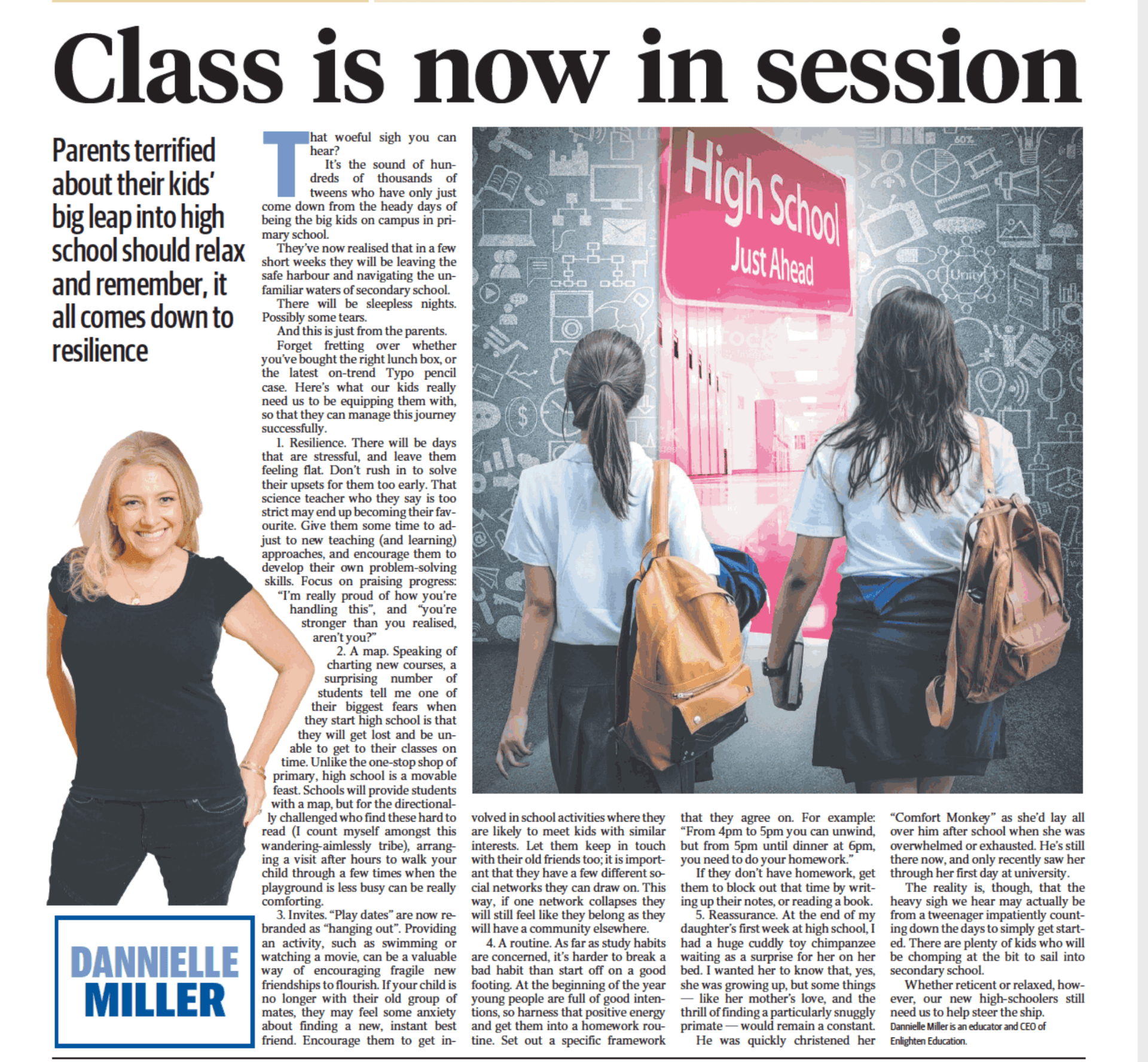
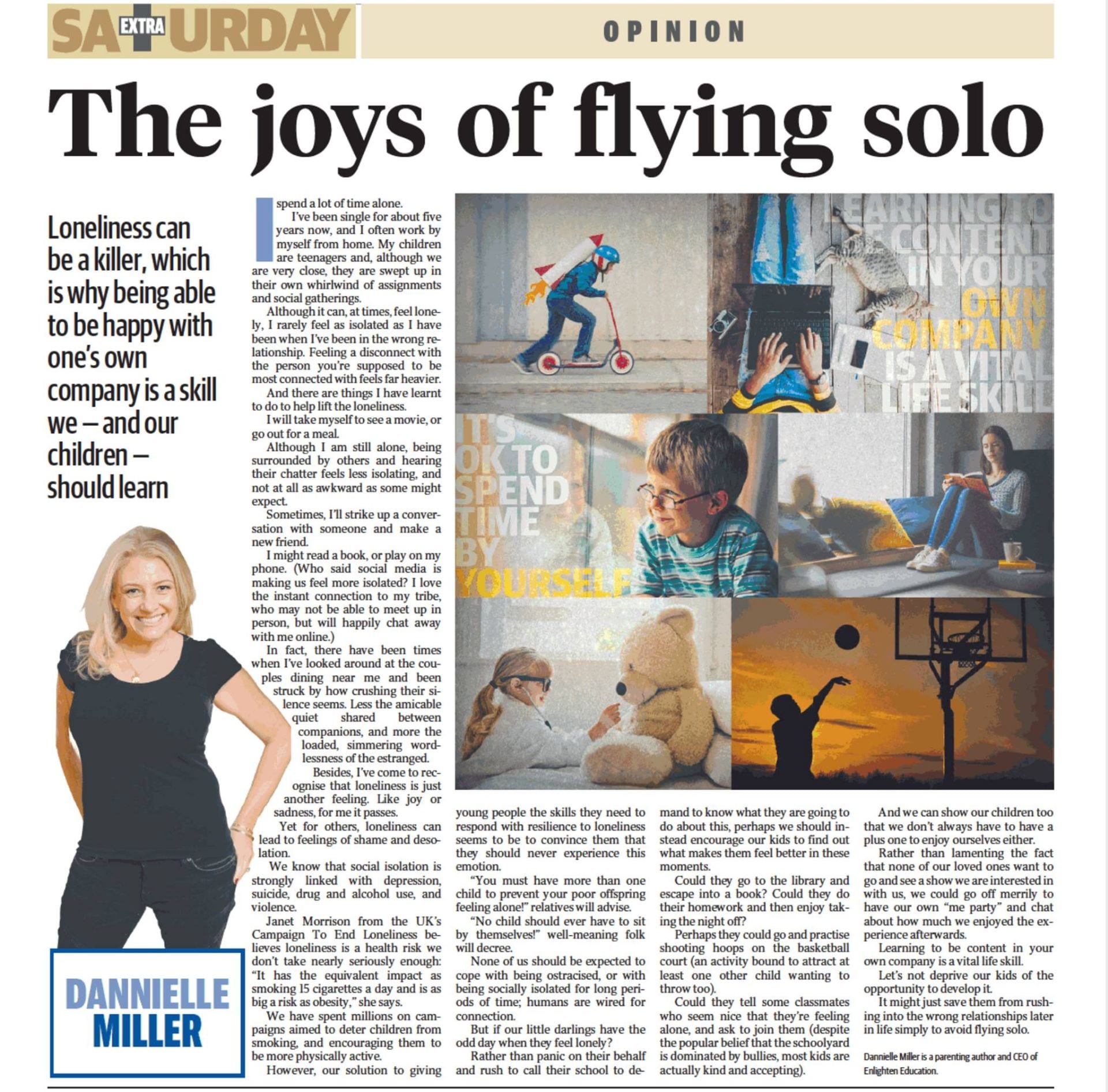
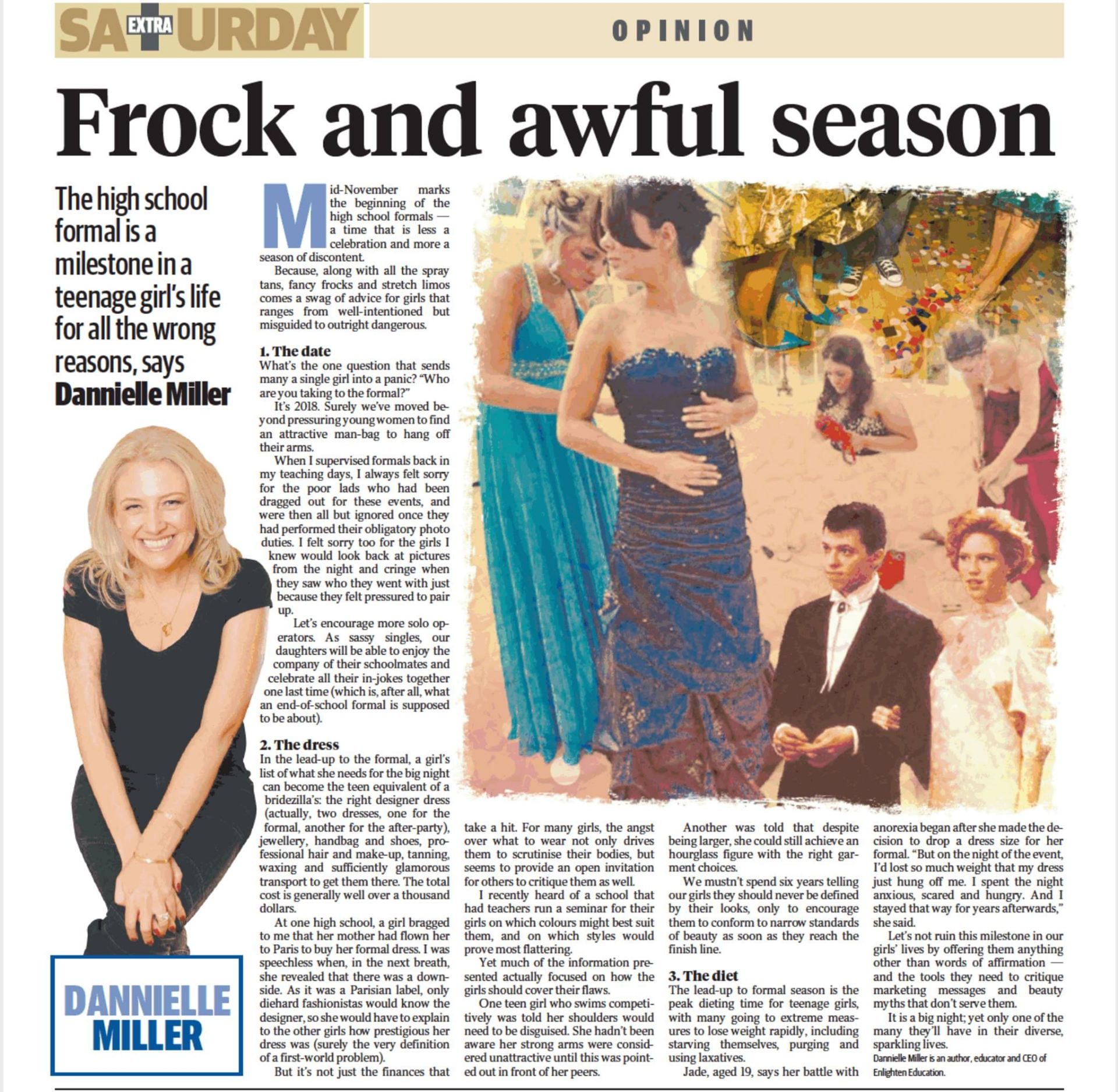
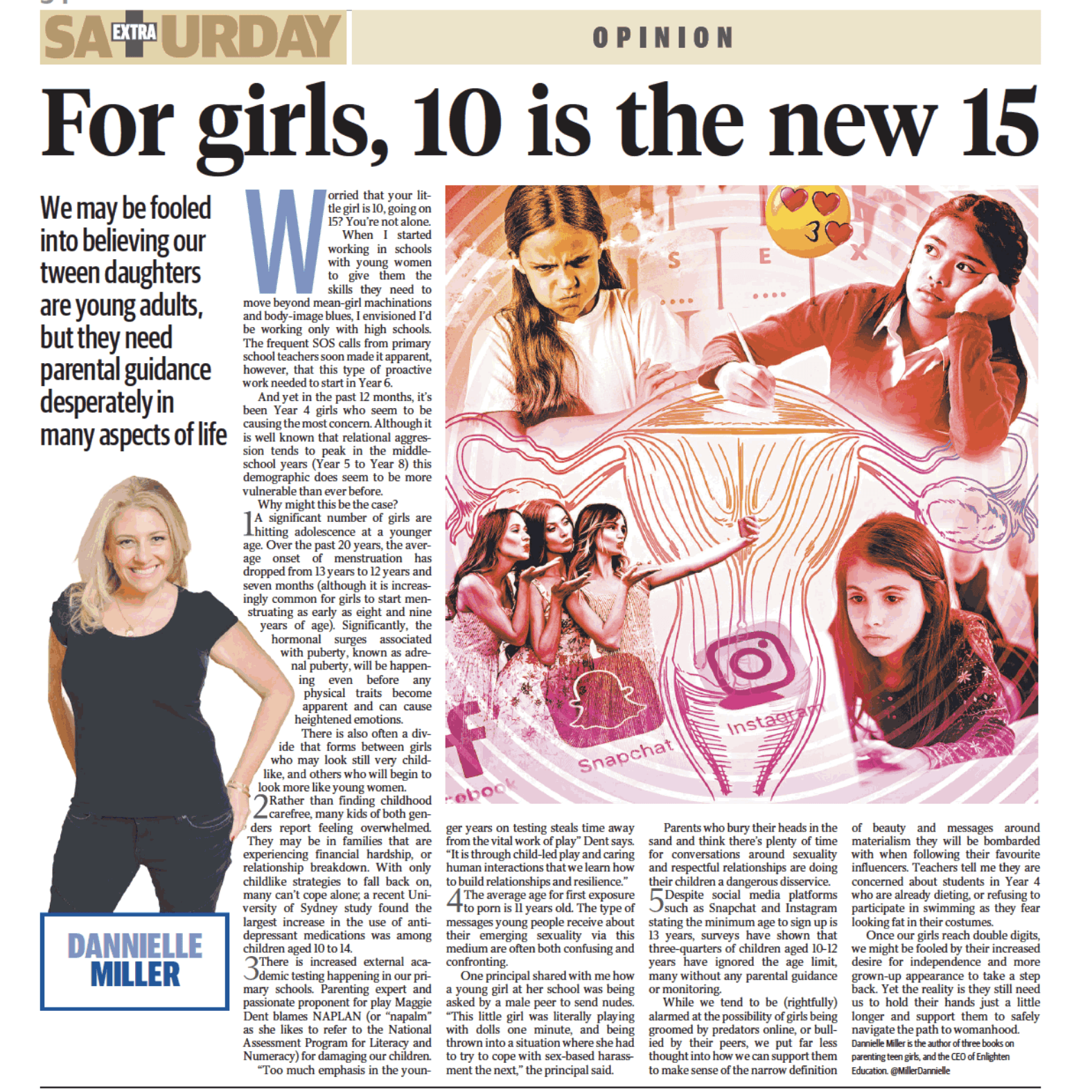
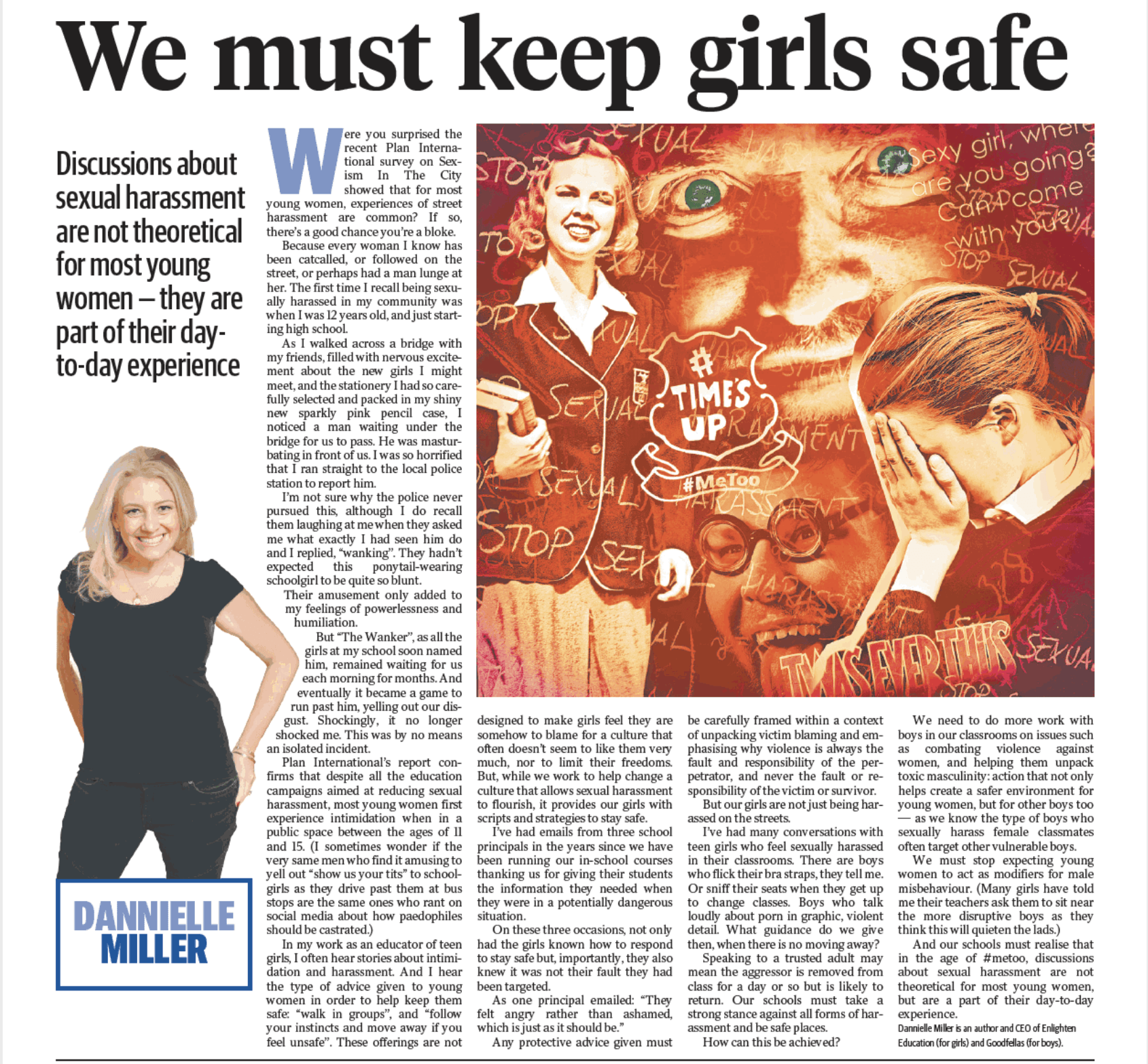
As an ex-English teacher and avid reader, I love books. They feed me - intellectually and emotionally. I was delighted to share my family’s passion for reading in the Sunday Telegraph last wekeend (if you click on this jpeg image below you should be able to read an enlarged version).      

When did my love affair with books begin?

When I was two years old I was badly burnt. I received third degree burns all down my right arm and neck. As is often the case with burn victims, I also suffered two major secondary infections - german measles and the potentially life threatening golden staph.

My Great Grandmother burnt me when I went with my Grandmother, her daughter, to visit her in Tasmania. She poured hot cooking oil down me as I set nearby watching breakfast being prepared. As a small girl I was always told this was an accident, yet I questioned why no one ever spoke of this women again, let alone saw her. Why hadn’t we forgiven her I wondered, after all, accidents do happen. It was only when I was older that the truth emerged. Great Grandma had been unstable and had shown signs of violence towards my beloved Grandmother when she was a small girl too. Everyone felt instinctively that she had done this to me deliberately.

I don’t remember whether it was done to me deliberately and ultimately, it does not make any difference. It happened.

What do I remember? Despite being so small, I do remember moments of this event, in particular my Grandmother’s face as she came through the doorway in response to my initial screams. I recall thinking I must be very badly hurt as she looked stricken.

I remember my Doctor too, as I was hospitalized for almost 6 months he became a central figure in my life. Dr Jemisson was kind, gentle, and doting. In his eyes, I could do no wrong. I was his special girl. Heaven help any nurse who dared keep me waiting! I remember gifts: in particular books. Perhaps this was the start of my love affair with words, as words so often soothed me to sleep -literally. I loved being read to. I escaped pain and boredom through tales of Princesses with power and through hearing about the adventures of other little girls who faced great dangers and emerged triumphant.

I soothed myself with words too. I could not yet read of course but I would talk to myself when frightened, repeating over and over the mantra “You’ll be ok, you’ll be all right.” It was my secret spell - and I would caste it to give me strength.

And my strength pulled me through. And I kept my arm. It just looked different to those of my friends with its red, raised, twisted flesh. It’s flap of skin near my elbow that looked taunt when my arm was stretched out, and hung loose when my arm was bent. Yet as a small child this difference did not concern me - I was so much more than my body!

I was a busy, bossy little girl. I had a younger sister to organise, lollies to eat, Barbies to collect and of course, once school started, more books to devour. Childhood for me was not about my body. Rather my body was merely and instrument to carry me from one adventure to the next. When I wanted to join my friends at the beach, I just had Mum cut the toes out of one of my father’s socks and popped that on to protect my arm from the sun. Problem solved!

Yet by the time I turned 10 years of age, things definitely changed. I started noticing boys. And I started noticing the girls the boys noticed. At school the boys preferred the alpha girls - popular, pretty, often good at sport. I was a pretty enough girl and had a few close friends, but as I was more interested in reading than netball, I was definitely not alpha material. It wasn’t just at school though that I received messages about what defined beauty and sexual attractiveness. My Barbies, Charlie’s Angels, ABBA…all taught me that to be a desired woman, I would need to be thin, beautiful and immaculately groomed. No scars allowed.

I entered adolescence and, like most girls, began a new internal conversation. I was no longer casting spells to heal myself. Instead, I was engaging in darker, self destructive thoughts and telling myself that I was not enough. Not pretty enough, not thin enough, not popular enough. Growing up into an adolescent girl, my feelings of inadequacy due to my scarring became quite overwhelming; I was still a bright and ambitious but my main preoccupation was with my scars and how best I could hide them from the world.

And as we choose to believe we are less because of how we look, and our inability to conform to a perfect image, we become less.

I hid. I hid my arm. I wore skivvies underneath my summer uniform, wore jumpers all year round, I avoided pools and beaches. My arm no longer seemed small - it seemed enormous. A huge, horrible, disfigured limb I would be forced to drag through what had been my oh- so promising life.

Yes, teenage girls are good at drama.

I vividly recall by the time I was 15 day dreaming about what my life would be like if I had not been burnt. I was tall, had very long legs and fancied that I could have been a bikini model if it had not been for my arm. How telling that as an adolescent my dream job was to be a bikini model! For many adolescents being some type of model is the dream job. It is not the actual job itself that appeals; it is the kudos, the knowledge that your body has been declared special. Worthy of attention. “If I looked that way, then they would love me…”

It was only in my adult years as an English teacher that I finally explored ways in which I might come to terms with my burns, indeed in many ways teaching forced me to come to terms with them as I was now a role model. If I could not accept myself, how could I possibly ask my students to accept themselves?

I searched once again for soothing words. And found them in the writing of women. Women like Naomi Wolf in the Beauty Myth - “We don’t need to change our bodies, we need to change the rules.” In women like Sofia Loren. “Nothing makes a woman more beautiful than the belief that she is beautiful”, and in the words of the young women I now taught, “I love how you wear your scars Miss, you don’t let them wear you.” Words healed me. And my self-talk became, once more, focused on my strengths rather than my perceived weaknesses.

I was ok. It did turn out all right.

In fact - life is magnificent. And I am a shiny girl. So here’s to all the writers who have healed and inspired me through their words.

Books can do more than merely entertain. They can help shape us. 

So, this week my dear readers, if you have not already done so, check out the professional library link (”My Library Thing”) on this blog and indulge in some of my favourite writers on all things girl related.

Read. And read to your children.

P.S I’d love to hear which books have helped shape you…

I am really enjoying sharing some guest posts written by various members of my amazing Enlighten team with you all! A warm “Butterfly Effect” welcome to New Zealand’s Program Manager Kelly Valder…


Guest post by Kelly Valder - newzealand@enlighteneducation.com

“Barbie Bitches” - what a term huh? For many it brings to mind platinum blonde hair extensions and lots of cleavage combined with skimpy pink clothing and an attitude that dictates that pretty and thin is everything and those who don’t shape up are clearly “losers”. And of course this term is used in the US (where Paris Hilton and co. are idolised) and sometimes in Australia ( Big Brother’s Bridgette leads the pack there at present) but not really in NZ…

Well, believe it or not, this term - and others like it - is now being thrown around here. Who would have thought? How did we get to this? In order to look for answers we firstly need to look at what’s happening around the globe.

A simple internet search under ‘teenage girls’ through international newspapers and educational journals exposes a variety of issues that are all alarming. In the U.S.A. it is reported that more than one in four teenage girls has at one time carried at least one sexually transmitted disease. A recent study of 25,000 European teenagers found that girls were three times more likely to commit acts of self harm than boys. Earlier this year in Australia, we learnt about Club 21, a group of teen school girls who encouraged their members to be ranked between 1 and 21 based on their thinness, good looks, binge drinking escapades and popularity with boys. And this is just a snapshot of some of the issues… scary!

So what’s happening here in Aotearoa?

• A New Zealand study found that 80% of females were within normal weight limits, but only 18% of them thought their weight was normal; 1
• 1 in 4 NZ teenage girls may suffer from the symptoms of an eating disorder; 1
• Dieting is a $100 million industry in NZ; 1
• The prevalence of emotional health problems, including depression, eating issues and suicidal behaviours, are alarmingly high amongst female students. The rates of these problems in NZ youth are up to twice those found in a recent national mental health survey of young people in Australia; 2

Not surprisingly, it seems then that our Kiwi girls are becoming just as obsessed with their looks as other teens around the globe.

What links may be emerging between the pressures girls are feeling to be beautiful and thin, and their behaviour?

Girls are no longer just silently imploding - they are also acting out. In March, two scantily clad teenage girls were found unconscious on an Auckland pavement, supposedly from an overdose of booze, party pills and ‘P’ (methamphetamine or crystal meth). Earlier this year a Napier family had their house targeted by aggressive and violent teenage girls. Education Ministry figures show a 41 per cent increase in girls being stood down, suspended or kicked out of school for assaults between 2002 and 2006. The way violence is dished out is changing too. Experts point to a new gang-like mentality among schoolgirls where a popular “queen bee” uses friends to bully or hurt to cement her position of power. The term “Barbie Bitches” became a frightening new part of our vernacular.

A few weeks ago the Good Morning programme featured a story on “Barbie Bitches” in our NZ schools. School principals reported that reality television has played a major role in creating these gangs of “Barbie Bitches” who are bullying either physically or through the cyber world. A quick look at television programs such as “Living Lohan” and “Americas Next Top Model” point to the fact that our educators may be right; these type of shows encourage girls to be ultra competitive and to play unfair in order to win. Don’t like someone? Just vote them out! Behave badly? Doesn’t matter as long as you look gorgeous doing it!

I can’t help but think that our NZ girls are crying out for positive role models and we need to step up and take action to provide them with some real alternatives right now!

Is it all doom and gloom? No. Not if we get on board and make our young women a priority. Our schools and the MoE are addressing  these issues with a low tolerance approach plus other more general initiatives including the ‘Team-Up’ site with information for parents and caregivers, new anti-bullying resources for schools released this month and ‘Ka Hikitia‘ an initiative aiming at improving educational outcomes for Maori students.

Thankfully, Enlighten Education, whose award winning programs I am proud to bring to NZ, is not the only organisation to realise that our girls are in crisis. There are fabulous resources, such as headspace.org.nz, that have been established to support our young people, their families and schools. However, Enlighten’s focus is unique as its programs have been specifically designed to cater to the particular needs, and the learning styles, of teen girls.

The Enlighten Education workshops are about celebrating all the things girls love about themselves, challenging them to rethink negative and destructive behaviours, and changing the way they respond to their environment and each other. It gives them the tools they need to “unpack” the images and messages they are bombarded with by the media as well as looking at strong, intelligent female role models who can inspire them to be all they can be. The CEO and co-founder of Enlighten Education, Dannielle Miller, summed up our wish for all girls beautifully in her recent post:  

“She’ll be a teen who will set boundaries, deconstruct all the mixed messages she will be presented with, and make choices she is truly comfortable with. She will not allow her sexuality to be shaped by misogynist music, plastic Paris-wannabe dolls, or the contemporary media environment that would have her believe that everyone is up for anything, all the time, and that to be hot she will have to get more make up and less clothes. She’ll grow up on her own terms. That is my wish for her. That’s my wish for all girls. That is what I will continue working towards.”

Barbie Bitches? No thanks!

1 Scary Statistics from around the world, article from www.nzhealth.net.nz taken from the BBC, Time, NewsWeek and research from the Canadian Medical Association Journal.
2 A health profile of New Zealand youth who attend secondary school, Journal of the New Zealand Medical Association, 04 April 2003, Vol 116, No 1171.
3 The health of New Zealand youth, Journal of the New Zealand Medical Association, 04 April 2003, Vol 116, No 1171.


Guest post written by Enlighten Eduaction’s Program Manager for South Australia, Jane Higgins.

What is really happening to our young people when they drink themselves into unconsciousness? Why do they feel the need to do this? What is missing from their lives?

According to recent media headlines, youth binge drinking has risen to epidemic proportions. The Australian Institute of Health and Welfare’s Director Penny Allbon, has reported that 9% of South Australian  adolescents (some 11,000 young people aged 14-19) are drinking alcohol at risky levels.

Further,
 one in five 16 -17 yr olds binge drinks weekly (1)
 44%, 12 yr olds have drunk alcohol in the past 12 months (2)
 24% of young people have used cannabis, 9% ecstasy and 8% amphetamines (3) and
 25% of deaths in this age group are related to alcohol (4).

It begs the question, what is being lost every week? Not just the many brain cells or lives, but the self esteem, the sense of self-worth, and the contributions these young people could be making to their own lives and the lives of others.

In Australia drinking is a significant part of every rite of passage. The ABC program 4 Corners (9-6-08) presented a segment called “On the Piss”. A young woman profiled articulated it beautifully when she said “What’s a wedding without booze? What’s a funeral without booze?” getting drunk is indeed a national pastime. It highlighted how young people are finding it incredibly difficult not to drink as alcohol surrounds them at every event they go to, and is a major element in the life of everyone they are connected to. The excellent new anti-drinking campaign “Drink Wise”, launched by the Australian Government, also challenges us to rethink this “booze goes with everything” approach.  

While alcohol has become part of every event we celebrate, drinking also occurs even when there is no  celebration, no milestone being marked. Some of today’s youth are drinking way beyond the glass of champagne or stubbie of beer at a friend’s birthday. They are regularly consuming a bottle of vodka in a session and then teaming it up with a caffeine loaded drinks such as Red Bull or V to make sure that when they are really drunk they are also really buzzed too. In a recent study of 4,271 University Students in the USA, they found mixing caffeine and alcohol resulted in the students being twice as likely to:

 be hurt and require medical attention
 travel with a drunk driver
 be at risk of being taken advantage of sexually.

I find these statistics very, very concerning. But sadly, not surprising.

What did surprise me was another article published in The Sunday Mail (9-6-08) on how being drunk and posting the antics on My Space, Facebook or YouTube has now become an instant means of gaining celebrity status for some young people. I personally don’t find anything glamorous about having vomit all over oneself, or having to spend the night in hospital from an injury caused by drunkenness, let alone knowing that those pictures are out in cyber space for all to see! This trend has particular implications for young women for as we have seen in the media, society is generally less forgiving of vision of the fallen woman - I cannot imagine headlines screaming about a male actor getting drunk and passing out in quite the same way they do when it is a Britney or a Paris. 

The Sunday Mail also visited Hindley Street to obtain a snap shot of what is really going on there on a Saturday night. Their video, Adelaide’s Binge Drinking Shame, can be viewed at
http://www.news.com.au/adelaidenow/video/. 

We cannot bury our heads in the sand and pretend this issue is not real. What is motivating this epidemic, and how do we protect our kids from doing so much harm to themselves and other people?

I don’t profess to have all the answers. However, my experiences as a mother, counsellor and as a senior presenter with Enlighten Education all lead me to conclude that we must strengthen our children’s sense of themselves, and educate them. We must teach them how to respond thoughtfully and authentically when they are faced with a decision about whether to bow to peer, and media, pressure. We must develop in them a deep sense of knowing what is really healthy and right for them. We must love them deeply too, and give them a strong sense of their uniqueness, beauty and purpose in the world.

Sanctions will only work up onto a point: we can limit the hours bars are open, tax alcohol, and ban alcopops, but in the end what do we really want? We want them to make safe and healthy choices for themselves and the only way of doing this is by teaching them to love themselves and showing them that they are indeed incredibly precious.

I favour a proactive appraoch. If our young people are personally fulfilled they will make better choices and limit the harm they do to themselves and others.

And binge drinking will no longer be needed to fill an empty void.

1. “Supporting Families of Young People with Problematic Drug Use”, 2008 released by the Government’s Advisory Body, The National Council On Drugs.
2. V. White, J. Hayman ‘Australian secondary school students’ use of alcohol in 2005 Report’ June 2006, Centre for Behavioural Research in Cancer at The Cancer Council Victoria
3. Teen Health, 2007 Vol 257 Issues in Society - Spinney Press
4. Professor John Toumbourou - Deakin University

P.S Danni’s previous post, “Getting trashed is so hot right now“, also offers some powerful insights into teen drinking and links to some really helpful resources.

Stealing innocence

The following link is to a discussion I had on Sunrise with former Democrats leader Lyn Allison on the art versus child porn debate. This issue reared its ugly head again as Australia’s Art Monthly chose to make a political statement by using higly sexualised naked images of six year old girl Olympia in their July edition. 

Dannielle Miller on Sunrise - child nudity in art

Below is a letter Melinda Tankard Reist had published in the Sydney Morning Herald today:

You say dignity, I say torture porn -

and ne’er the twain shall meet

Art is about “giving people dignity”, the critic Robert Nelson told ABC radio this week. “We’ve got to have faith in art,” he implored.

Nelson is the father of Olympia, whose naked photos appear in Art Monthly Australia’s latest issue. The photos were taken in 2003 by her mother, when the girl was six.

Flicking through Art Monthly, I wondered whether Mr Nelson had looked at the magazine that featured his daughter before he gave us his thoughts on art and human dignity.

Call me particular, but I don’t find images of semi-naked, bound women with protruding sex organs all that dignified. I looked really hard, but I couldn’t see much dignity in the photograph of a Japanese schoolgirl trussed in rope and suspended with her skirt raised to reveal her underwear.

Torture porn just doesn’t stir my soul.

Some of Bill Henson’s images are there (of course - this issue was a “protest” in defence of his work). They are  followed by selections from the work of the Japanese photographer Nobuyoshi Araki, probably best known for his passion for taking photos of girls and women exposed and bound.

There’s his slumped, bound, schoolgirl picture and an image of a woman with her clothing stripped back, the ropes squeezing her naked breasts and contorting her into a pose that displays her genitals. A third uplifting work depicts a woman on the ground, strained forward, her naked spreading backside to the camera.

Faith in art?

A little further into the magazine you come upon the work of David Laity. What offering of truth and beauty does Laity give us? An image of a woman being bound with the tentacles of an octopus as it performs oral sex on her.  That’s some dignified octopus.

Then there’s an image of a woman bending over so we can see her … well, you get the picture.

The photographs of Olympia need to be viewed in the context of the images positioned around her. On their own, the images that show Olympia reclining naked, her pose and look more that of an adult, can be seen as sexualised. But surrounding her with these other images superimposes a further, more sinister, meaning on them.

The former Democrats senator Lyn Allison told Sunrise the controversy was just about little girls playing dress-ups. But don’t dress-ups usually involve putting clothes on, not taking them off? And does this game usually end with your photo published in a gallery of female genitals? The magazine’s editor said he wanted to “restore dignity to the debate”. Does he really think he’s achieved that?
Artists who recognise there should be ethical constraints to art; artists who don’t think it advances humanity to tie  up naked girls and capture their images  - now that would be dignified.

Melinda Tankard Reist

Canberrra

Love to hear your thoughts.


Unlike most little girl’s dolls, which are designed to represent older teenagers or women, Mattel’s “My Scene, Growing Up Glam” doll openly set out to depict a tween, a girl aged 8-13 years. She is dressed in lace stockings, short skirt, diamante belt, midriff top and wears a full face of heavy make-up ( complete with false eye lashes). Her cute accessories? A teddy bear and school books:

Twist the screw on her back (oh how symbolic!) and her abdomen stretches. It’s gruesome to watch. She looks like she is being stretched by a medieval torture device.

Hey presto! Now she’s a “curvy, cool teen.” But wait, you say, all that has really changed is that her stomach has stretched to make her appear taller! 

How telling. It seems there is no physical difference between an 8 year old girl and an older teen in Mattel land.  Nor should the clothes they wear differ. The accessories do change though - she trades in her school books and teddy bear for a full make up kit (”Whoa, her make up changes too!”) and some glossy fashion magazines. Flats shoes are out - its all about the stilettos now. Out too with cute hair clips and in with designer sunnies.


Where do I begin in explaining why this type of doll is so toxic for our daughters? And why do I feel I must actually explain why this is not acceptable. Isn’t it self-evident?

In the wake of the Senate tabling the findings of its much anticipated inquiry into the sexualisation of children in the contemporary media environment in parliament last week, more than ever I feel I need to justify my concerns.

The committee observed “…that children are certainly more visibly sexualised in terms of the media to which they are exposed. This basic assumption was not challenged by any evidence received, and is based on recognition of the increasing targeting of products to child-related markets and the greater exposure of children to information via the many available media forms, and particularly the Internet. However it would be a mistake to equate these influences with actual harm.”

Why would it be a mistake to equate these influences with actual harm? Because not enough long term research has been done yet on the impact of the sexualisation of children on their physical and mental health? Does anyone think for one moment that any research that is commissioned will come back showing that stealing childhood has actually been helpful? Healing? Why do we need to wait for more numbers to come in before we act - there has already been a large body of research that has alerted us to numerous potential dangers including an increase in eating disorders, self harm, risky sexual practices.   Why can’t we err on the side of caution when it comes to protecting children?

Clive Hamilton, former Director of the Australia Institute whose report ‘Corporate P-dophilia’ prompted the Senate Inquiry, summed up the recommenations thus: “The recommendations..amount to nothing more than a polite request that advertisers and broadcasters might perhaps, if it’s not too much trouble, consider listening to community concerns a little more.”

I have found the debate surrounding the Inquiry very interesting too. Those who dare question the path society is taking have been labelled prudish, out of touch, alarmist. Catherine Lumby, the Director of Journalism  and Media at UNSW, expressed concern that some commentators were viewing children as “uncovered meat”, she told the world she was “furious” that children were being made to feel ashamed about their bodies.  

I will join Catherine in her fury if anyone dares suggest children’s bodies are provocative and need to be covered up. I too will dismiss as alarmist anyone who wants nappy advertisements banned. But I haven’t met, nor heard, from any of these types. I haven’t seen people up in arms over singlets, or nappy ad’s or innocuous pictures of girls looking pensive. Such people may well exist at one end of the continuum, just as those that design t-shirts for toddlers emblazoned with “All my Daddy wanted was a blow job” do exist at the other end of the scale. 

Do I have a problem  with little girls wearing singlet tops? Absolutely not - unless they are emblazoned with slogans like “Porn  Star”, “Flirt” or “Tease.” A 10 year old girl I worked with in a school recently turned up at her school camp wearing a shirt that read, “Wrap your lips around this.” Can you see why I might be concerned about that Ms Lumby? And this is not by any means another extreme example. Raunchy messages aimed directly at young girls are mainstream.

I am concerned too not just because I think there are too many hyper-sexualised messages bombarding our girls, but becuase the messages presented are so narrow. It’s all big (fake) breasts, pouts, and male fantasy soft porn. It’s all Hugh Hefner bunnys and pole dancing. Women’s sexuality (and men’s) is in reality so much more diverse and complicated. Just as we are told that only a leggy blonde size 8 model can be truly beautiful, we are now being told only a busty, wet and wild blonde can be truly sexy.       

And Ms Lumby just for the record, I have never had a problem with teen girl magazines offering age appropriate advice on sexuality. Magazines are a valuable source of information as some parents do feel uncomfortable having these important conversations with their children. But I do think some of the advice and articles offer too much too soon - do tweens and teens really need detailed information on anal sex and to be told it is a “personal choice” ? Isn’t there a risk that a twelve year old will feel left out when she reads in the June issue of Dolly that over 21% of the readers profiled in their sealed section say they lost their virginity between the ages of 10-13?

And it’s not even just the advice and articles that concern me - it is the mixed messages buried within the pages that really trouble me. The mag’s occasionally do offer great articles on self esteem and body image, yet they allow advertisements for mobile downloads that include slogans like “Save a virgin, do me instead” and “Fancy a quickie?” I never wanted magazines to be banned. I just wanted common sense self-censorship, and age appropriate guidelines on the covers to alert parents and readers to the fact that the content might not be as innocuous as the oh-so-wholesome airbrushed covers might lead one to believe. It seems even this was asking too much. 

Do I sound like a sore looser? I feel like one. There was a lot to loose.

I am comforting myself by holding on to the belief that despite the senate’s softly, softly approach, the process itself has at least brought about a heightened awareness of the issues.

Instinctively, we all know that we do not need a government report, or a team of academics, or a myriad of research papers to tell us that enough is enough.

And despite the divisions there is one point on which every one seems to agree - education is key. Girls and boys, now more than ever, need to be savvy media navigators. They need to be given the skills they need to make sense of the adult world that is becoming more and more part of their childhood world too. Teaching and helping girls navigate Girl World is the work that I love passionately, and it is the work that my team and I are gifted in doing well. 

Education works. 

This week my own real life “too cute tween” , an eleven year old girl I worked with at a school recently, was told by her dance teacher that she had to start wearing not just a full mask of make-up for her dance concerts, but false eye lashes too. When her mother, who has completed my course for parents, questioned why this was really necessary she was told by the dance teacher that the eye lashes would “increase her (daughter’s) confidence.” Mum and “Ms Enlightened Tween” are both saying no. Neither are comfortable with this and both feel that long batting eyelashes are just too much. As is so often the case, the dance teacher tried making Mum feel stupid - “But all the other parents think it is fine.” When Mum investigated this claim, she found that four out of the ten dance mothers were also actually really worried about the appropriateness of wearing false eye-lashes but they had been scared to speak out.

And whether you think the eyelashes were actually harmless or harmful is ultimately immaterial. What I love is the fact that this little girl will no longer allow herself to be stretched and pulled into becoming a “curvy, cool teen.”  

She’ll be a teen who will set boundaries, deconstruct all the mixed messages she will be presented with, and make choices she is truly comfortable with.  She will not allow her sexuality to be shaped by misogynist music, plastic Paris-wannabee dolls, or the contemporary media environment that would have her believe that everyone is up for anything, all the time, and that to be hot she will have to get more make up and less clothes. 

She’ll grow up on her own terms.   

That is my wish for her. That’s my wish for all girls. That is what I will continue working towards.

P.S In an effort to offer parents something positive they can latch on to a resource, I have asked Women’s Forum Australia to reproduce here an article from their excellent publication “Faking It.” The extract below in PDF format is entitled ” The sum of your body parts - reducing women to sex objects: how it happens and how it hurts us.” It is a great catalyst for conversation - and we must continue having powerful conversations. 

fakingit_sumbodyparts_lowres

Interested in finding out more? “Faking It” is also being launched in Sydney in July:   

Time:        8pm – 9.15pm

Date:        Friday, 18th July

Venue:     Darling Harbour Sydney Convention and Exhibition Centre, Bayside  

This will be one of the World Youth Day events, a chance for the Get Real! message to go global. The event is open to all, even those who are not official WYD participants: go along and be empowered and inspired to GET REAL! I spoke at the launch held in Perth earlier this year and thought the night was just brilliant. So inspiring! For more information, or to let them know that you’re coming, contact

Erica on 0414-690-487, or email WFA at: nsw@womensforumaustralia.org 

Finally, the PDF below is the Facilitator’s guide for the Canadian Documentary on the sexualisation of children entitled “Sexy Inc.” Even if you have not seen the film, the booklet offers excellent discussion questions:

sexy-inc-facilitators-guide

STOP PRESS - there has been a change of venue for the “Get Real” event - it will now be held in the Parkside Ballroom, Sydney Convention Centre. Same start time. I have been asked to be the MC - hope to see you there!  


Older Posts »